
Posted by Nikhil Khanpara
on June 23, 2026

You notice it in the shower drain. On your pillowcase. In your hairbrush. Hair thinning and slow growth affect millions of women — and the emotional weight of watching your hair change is real. What most women don't know is that the root cause is often nutritional: research suggests the majority of women are deficient in at least one key vitamin for hair growth. The good news? The right supplementation strategy can make a measurable difference. In this guide, we break down the 7 best vitamins for hair growth in women — biotin, iron, vitamin D3, folate, zinc, vitamin E, and collagen — what the science says, and the most effective way to absorb them daily.
Why Do Women Lose Hair or Experience Slow Growth?
Hormonal Shifts (Postpartum, Menopause, PCOS)
Hormones are among the most powerful regulators of the hair growth cycle. Postpartum estrogen drops trigger telogen effluvium — a sudden, diffuse shedding that typically peaks 3–4 months after delivery. Menopause brings declining estrogen and rising androgens, which can miniaturize follicles over time. PCOS-related androgen excess similarly disrupts the follicle environment, leading to thinning at the crown and temples. In all three cases, nutritional support becomes especially critical because hormonal stress depletes key micronutrients faster.
Nutritional Deficiencies as a Root Cause
Hair follicles are among the most metabolically active structures in the body — they require a constant, rich supply of micronutrients to sustain rapid cell division. When intake or absorption falls short, the body deprioritizes hair growth in favor of essential organ function. Almohanna et al. (2019, Nutrients) confirmed that deficiencies in iron, zinc, vitamin D, and B vitamins are directly associated with non-scarring hair loss in women.
Stress, Crash Dieting & Telogen Effluvium
Physical or psychological stress — including crash dieting, illness, or major life events — can push a large percentage of follicles into the telogen (resting/shedding) phase simultaneously. This is telogen effluvium, and it's one of the most common causes of sudden hair loss in women aged 20–45. Restrictive diets compound the problem by depleting iron, zinc, and B vitamins at the exact moment the body needs them most.
The 7 Best Vitamins for Hair Growth in Women
1. Biotin (Vitamin B7) — The Hair Growth Classic
Biotin is the most recognized vitamin for hair growth — and for good reason. It plays a central role in keratin synthesis, the structural protein that makes up 95% of each hair strand. Biotin supports the keratin infrastructure by activating enzymes involved in amino acid metabolism, directly influencing the strength, thickness, and growth rate of hair.
Deficiency signs to watch for: Hair thinning, brittle nails, dry scaly skin around the nose and mouth, and fatigue. True biotin deficiency is rare in healthy adults, but subclinical insufficiency — particularly in women who consume raw egg whites regularly or take certain anticonvulsant medications — is more common than recognized.
2. Iron — The Most Overlooked Hair Loss Culprit
Iron deficiency is the single most common nutritional deficiency in women worldwide — and one of the most underdiagnosed causes of hair loss. The connection lies in ferritin, the body's iron storage protein. Trost et al. (2006, Journal of the American Academy of Dermatology) established that low ferritin levels are significantly associated with diffuse hair shedding in premenopausal women, even when hemoglobin remains in the normal range.
This is critical: standard blood panels often miss iron-related hair loss because they don't test ferritin. If you're experiencing unexplained shedding, request a ferritin-specific test. Target ferritin levels above 70 ng/mL for optimal hair growth support.
3. Vitamin D3 — The Follicle Activator
Vitamin D receptors are expressed in hair follicle keratinocytes, and research has consistently linked low vitamin D levels to alopecia areata and female pattern hair loss. Almohanna et al. (2019) noted that vitamin D plays a role in creating new hair follicles and may help reactivate dormant ones. Given that an estimated 40% of US adults are vitamin D insufficient, this is a high-yield target for women experiencing unexplained thinning — especially those with limited sun exposure or darker skin tones.
4. Folate (Vitamin B9) — Cell Renewal for Faster Growth
Hair follicles are among the fastest-dividing cells in the human body — each follicle cycles through complete cell renewal every few days. Folate is essential for DNA synthesis and rapid cell division, making it a foundational nutrient for hair growth rate. Deficiency slows follicle cell turnover, leading to thinner, slower-growing strands. Folate is particularly important for women on hormonal contraceptives, which are known to deplete B vitamin levels over time.
5. Zinc — Sebum Regulation and Follicle Repair
Zinc serves a dual function in hair health: it regulates sebum production (keeping the scalp environment balanced) and supports the repair of damaged hair follicle tissue. Rushton (2002) identified zinc deficiency as a contributing factor in diffuse hair loss, noting that zinc supplementation in deficient individuals produced measurable improvements in hair density. Zinc also inhibits the enzyme 5-alpha reductase, which converts testosterone to DHT — the androgen most associated with follicle miniaturization.
6. Vitamin E — Scalp Circulation and Antioxidant Protection
Vitamin E is a fat-soluble antioxidant that protects scalp tissue from oxidative stress — a key driver of follicle damage and premature aging. Beyond antioxidant protection, vitamin E supports microcirculation in the scalp, ensuring follicles receive adequate oxygen and nutrients. A small but well-designed study found that tocotrienol supplementation (a form of vitamin E) increased hair count by 34.5% over 8 months compared to placebo.
7. Collagen Peptides — The Structural Support Layer
Collagen is the primary structural protein of the dermis — the skin layer that anchors hair follicles. As collagen production declines with age (beginning as early as the mid-20s), the dermal matrix weakens, reducing follicle anchoring strength and contributing to thinning. Hydrolyzed collagen peptides provide the amino acid building blocks (particularly proline and glycine) needed to rebuild this matrix.
Which Vitamin Deficiency Is Most Likely Causing YOUR Hair Loss?
Quick Self-Assessment Checklist
Match your symptoms to the most likely deficiency:
- Diffuse shedding + fatigue + heavy periods → Iron/Ferritin deficiency
- Brittle nails + dry skin + hair breakage → Biotin insufficiency
- Thinning at crown + low mood + limited sun exposure → Vitamin D3 deficiency
- Slow growth + on hormonal birth control → Folate or B12 depletion
- Oily scalp + slow regrowth after shedding → Zinc deficiency
- Scalp sensitivity + dull, brittle strands → Vitamin E insufficiency
- Overall thinning + aging skin + joint discomfort → Collagen decline
When to Get a Blood Panel Done
If you've been experiencing hair loss for more than 3 months, a targeted blood panel is worth the investment. Request: ferritin (not just serum iron), 25-OH vitamin D, zinc, folate, B12, and a full thyroid panel (TSH, free T3, free T4). Many hair loss cases that appear cosmetic have a clear, correctable nutritional or hormonal root cause.
How to Choose the Right Hair Growth Supplement
What to Look for on the Label
Prioritize supplements that list the specific form of each nutrient — not just the name. For example: methylfolate over folic acid (better absorbed, especially for women with MTHFR variants), ferrous bisglycinate over ferrous sulfate (gentler on the stomach, higher absorption), and cholecalciferol (D3) over ergocalciferol (D2). Avoid proprietary blends that obscure individual dosages.
Capsules vs. Gummies vs. Strips — Absorption Comparison
Capsules must dissolve in the stomach and pass through the digestive tract before nutrients enter the bloodstream — a process that can take 45–90 minutes and is significantly affected by gut health, food intake, and digestive enzyme activity. Gummies are palatable but typically contain lower doses, added sugars, and binding agents that can interfere with absorption. Sublingual strips dissolve directly under the tongue, delivering nutrients through the oral mucosa directly into the bloodstream — bypassing first-pass metabolism entirely. For fat-soluble vitamins like D3 and E, and for biotin, this delivery method represents a meaningful bioavailability advantage.
Why Bioavailability Matters More Than Dosage
A 10,000 mcg biotin capsule that's 20% absorbed delivers less active biotin than a 2,500 mcg sublingual strip at 80% absorption. The number on the label is only half the story — the delivery mechanism determines how much actually reaches your follicles. This is why format innovation matters in the supplement space, and why sublingual delivery is gaining traction among clinicians and biohackers alike.
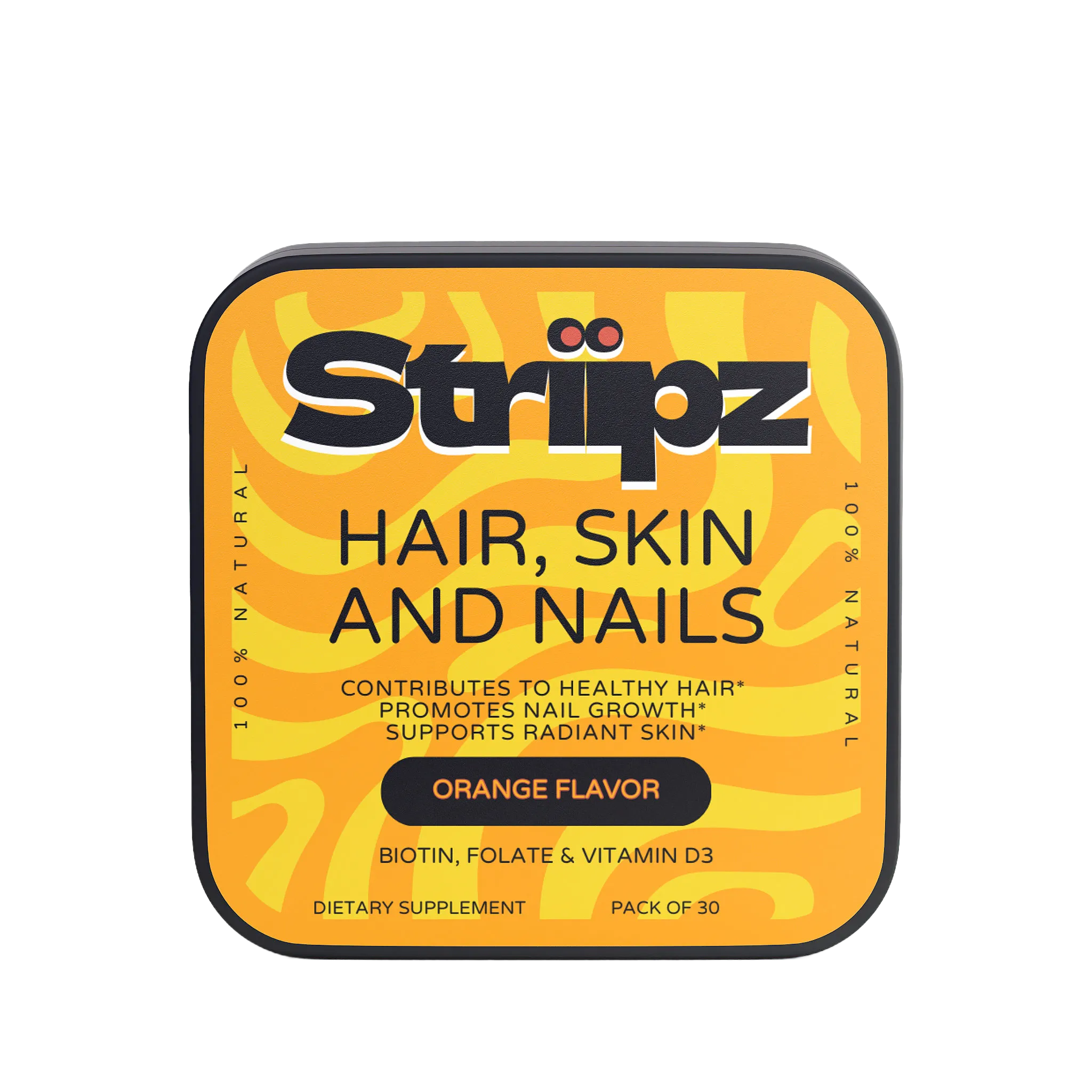
⚡ The most bioavailable way to take your hair vitamins? The Striipz Hair, Skin & Nails Strip — a precision-dosed sublingual strip with biotin, collagen support nutrients, and key vitamins that dissolve in seconds. No pills, no gummies, no guesswork.
How Long Does It Take for Vitamins to Grow Hair?
The Hair Growth Cycle Explained (Anagen, Catagen, Telogen)
Hair grows in three phases: Anagen (active growth, lasting 2–7 years), Catagen (transition, 2–3 weeks), and Telogen (resting/shedding, 3–4 months). At any given time, roughly 85–90% of your hair is in anagen. Vitamins and supplements work by optimizing the conditions for anagen — they don't override the cycle, they support it. This is why patience is essential: you're working with biology, not against it.
Realistic Timeline: What to Expect at 30, 60, 90 Days
- Days 1–30: Reduced shedding may begin as nutritional deficiencies are corrected. No visible new growth yet — follicles are being nourished at the root level.
- Days 30–60: Some women notice baby hairs or new growth at the hairline. Existing strands may feel stronger and less prone to breakage.
- Days 60–90: Measurable improvement in density and growth rate for most women with a nutritional root cause. Full results for those with hormonal or structural factors may take 4–6 months.
Signs the Supplement Is Working
Less hair in the shower drain. Reduced breakage when brushing. New growth visible at the temples or part line. Stronger, less brittle nails (a reliable proxy for biotin and collagen uptake). Improved scalp condition — less dryness or excess oil. These are the early signals that your follicles are responding.
Foods That Naturally Boost Hair Growth Vitamins
| Nutrient | Top Food Sources | Notes |
|---|---|---|
| Biotin | Eggs (cooked), almonds, sweet potato | Raw egg whites block biotin absorption |
| Iron | Grass-fed beef, lentils, spinach | Pair with vitamin C to enhance absorption |
| Vitamin D3 | Fatty fish, egg yolks, fortified dairy | Sun exposure is the primary source |
| Folate | Dark leafy greens, chickpeas, avocado | Heat-sensitive — eat some raw |
| Zinc | Oysters, pumpkin seeds, beef | Plant zinc is less bioavailable |
| Vitamin E | Sunflower seeds, almonds, olive oil | Fat-soluble — absorb with dietary fat |
| Collagen | Bone broth, skin-on chicken, fish | Vitamin C required for collagen synthesis |
| Vitamin C | Bell peppers, kiwi, citrus | Enhances iron and collagen absorption |
| Omega-3s | Salmon, walnuts, flaxseed | Supports scalp anti-inflammation |
| Protein | Eggs, Greek yogurt, legumes | Hair is 95% keratin — protein is foundational |
Frequently Asked Questions
Which vitamin deficiency causes hair loss in women?
Iron (ferritin) deficiency is the most common nutritional cause of hair loss in women, followed by vitamin D, zinc, and biotin. Almohanna et al. (2019) identified these four as the highest-yield targets for investigation in women with non-scarring hair loss. A targeted blood panel is the most reliable way to identify your specific deficiency.
Does biotin really work for hair growth?
For women with biotin deficiency or insufficiency, yes — supplementation produces clear improvements in hair strength and growth rate. For women with adequate biotin levels, the evidence for additional benefit is weaker. That said, biotin is water-soluble and safe at high doses, making it a low-risk addition to a comprehensive hair supplement stack.
How much biotin should a woman take daily for hair growth?
Clinical studies on hair and nail health have used doses ranging from 2,500 mcg to 10,000 mcg daily. The RDA is only 30 mcg, but therapeutic doses for hair growth are significantly higher. Most high-quality hair supplements provide 2,500–5,000 mcg. With sublingual delivery, lower doses achieve equivalent or superior results due to higher bioavailability.
Can vitamins regrow lost hair?
If hair loss is caused by a nutritional deficiency, correcting that deficiency can absolutely restore growth — including in follicles that have been dormant for months. If hair loss is caused by scarring, advanced androgenetic alopecia, or autoimmune conditions, vitamins alone are unlikely to reverse the loss, though they can slow progression and support overall scalp health.
Is it safe to take hair growth vitamins every day?
Yes, for the vitamins covered in this guide. Water-soluble vitamins (biotin, folate, vitamin C) are excreted in excess and pose minimal toxicity risk. Fat-soluble vitamins (D3, E) should be taken at evidence-based doses — excessive vitamin D supplementation can cause toxicity, though this requires sustained very high doses. Iron supplementation should be guided by blood test results, as excess iron has its own risks.
Conclusion
Hair growth isn't about finding a magic pill — it's about giving your follicles the consistent, bioavailable nutrition they need to do what they're designed to do. Sporadic high-dose supplementation rarely works; daily, well-absorbed delivery does. Whether your root cause is iron deficiency, a vitamin D gap, or postpartum depletion, the right supplement stack — taken in the right format — can meaningfully change your hair's trajectory. Start your 90-day hair journey with the Striipz Hair, Skin & Nails Strip — sublingual delivery, precision-dosed, and designed for women who want results they can actually see. Shop Hair, Skin & Nails Strips →